
Search is no longer limited to a list of blue links on Google, but it has not left SEO behind.
Today, people are asking ChatGPT for recommendations. They are reading Google AI Overviews and using tools like Perplexity and voice-style search platforms to compare businesses & quick direct answers.
For businesses, this creates a new visibility challenge.
It is no longer enough to ask, “Are we ranking on Google?” A better question is, “Can AI systems understand our business well enough to mention us when customers ask?”
The answer starts with strong SEO.
AI search may feel new, but it still depends heavily on the same thing Google has always needed: clear, useful, well-structured, search-intent content, trust signals, and easy-navigable website structure. If your website does not explain who you are, what you offer, where you serve, and why customers trust you, AI systems have very little to work with.
Whether you run a clinic, law firm, construction company, dental practice, home service business, e-commerce brand, or local professional service, SEO helps search platforms understand the whereabouts of your business and why people should trust you.
For a growing business, working with a digital marketing company in Toronto is no longer about chasing every new platform. It is about building a stronger digital presence that both people and AI systems can understand.
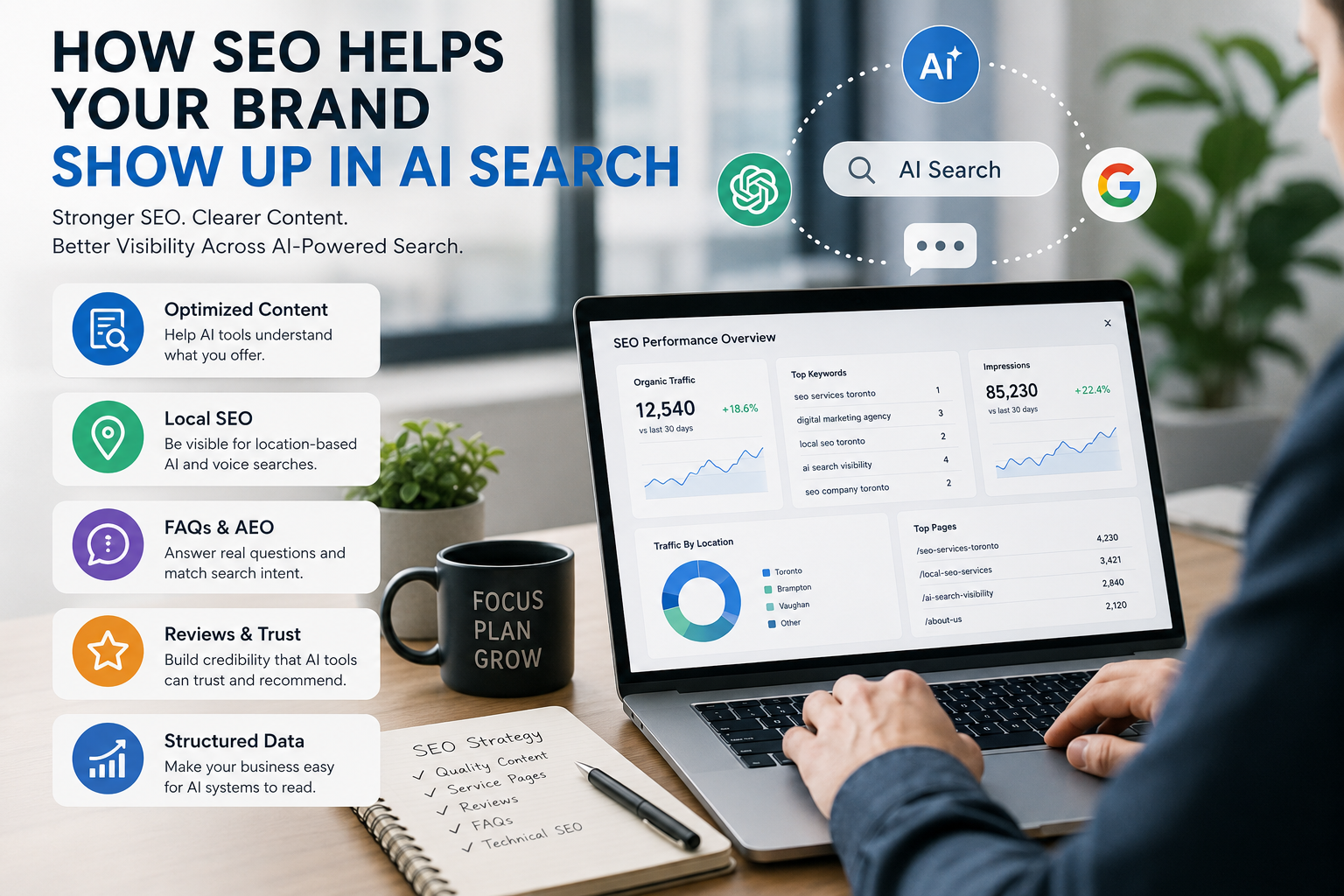
Here are 5 practical ways SEO can help surface your brand on AI search.
AI search tools do not create business knowledge from nowhere.
When someone asks an AI, “Who offers reliable accounting services near me?” or “Which clinic provides laser treatments in Toronto?” the tool needs to understand which businesses are relevant. It does that by reading and interpreting information available online.
That includes your website, service pages, blogs, FAQs, reviews, business listings, social profiles, and third-party mentions.
If your website has thin service pages, vague descriptions, outdated blogs, or missing location details, AI tools may struggle to understand what your business actually does. Even if your brand is credible offline, that credibility must be reflected online.
Strong SEO content fills those gaps.
It helps answer questions such as:
What does your business offer?
Who is your service for?
Which areas do you serve?
What problems do you solve?
What makes your business credible?
What do customers say about you?
Is your information consistent across the web?
The clearer your content is, the easier it becomes for both people and AI tools to understand your business.
This is why businesses that invest in detailed service pages, helpful blogs, FAQs, case studies, and location-focused content often have a better foundation for AI visibility.
A digital marketing company in Toronto, for example, should not only have a homepage that says “we do marketing.” It should clearly explain its SEO services, local business marketing experience, small business consulting support, website strategy, content process, and measurable outcomes.
AI search works better when your business information is easy to identify, compare, and summarize.
Your service pages are not just pages for Google rankings. They are also some of the clearest signals that explain your business to AI systems.
A well-optimized service page tells both search engines and customers exactly what you offer. It should include the service name, target audience, location, process, benefits, common questions, and proof of experience.
For example, a generic service page might say:
“We help businesses grow online.”
That sounds fine, but it does not give much context.
A stronger SEO-focused service page would explain:
“We help small businesses in Toronto improve local visibility through SEO strategy, website optimization, content planning, Google Business Profile improvements, and monthly performance tracking.”
That second version gives AI systems more useful information. It connects the business to a service, audience, location, and method.
This matters because AI-generated answers often respond to specific search intent. A customer may ask:
“Who can help my small business rank better in Toronto?”
“What should I look for in an SEO agency in Toronto for a local service business?”
“Which digital marketing company in Toronto works with small businesses?”
If your service pages are clear and well-structured, your brand has a stronger chance of being understood as a relevant option.
Service page optimization should include:
The goal is not to stuff keywords. The goal is to remove confusion.
When your website clearly explains your business, AI tools are more likely to interpret it correctly.
Keywords still matter, but not in the old mechanical way.
AI search is better at understanding natural language, but it still needs strong topic signals. When your content includes the words, phrases, and questions your customers actually use, it becomes easier for search systems to connect your business with the right intent.
The key is to use keywords naturally.
A local customer may not search with technical terms. They may ask:
“Who offers emergency dental care near me?”
“What is the best treatment for acne scars?”
“How much do custom blinds cost?”
“Which event venue is good for a corporate dinner?”
“Do I need SEO for AI search?”
Your content should reflect how real people ask questions. That includes service keywords, location keywords, problem-based phrases, and comparison-style topics.
Keyword-rich content does not mean repeating the same phrase again and again. It means building content around a complete topic.
For example, a page about “SEO services in Toronto” should also cover related ideas such as local SEO, website audits, Google Business Profile optimization, content strategy, technical SEO, and AI search visibility. This helps search systems understand the full scope of your service.
The stronger your topic coverage, the easier it is for AI systems to understand where your business fits.
A common mistake is writing content only for search engines. The better approach is to write for real buyers and structure the content in a way search systems can understand.
That means using keywords naturally in:
When done well, keyword-rich content does not feel forced. It feels specific.
And specificity is exactly what AI systems need when deciding which brands may be relevant to a user’s question.
AI search is built around questions.
People are not only searching short phrases anymore. They are asking complete questions, such as:
“How long does SEO take for a small business?”
“Can SEO help my business appear in AI search?”
“What makes a business show up in ChatGPT or Google AI Overviews?”
“Do reviews help with AI search visibility?”
“What should I fix on my website before hiring a marketing company?”
This makes FAQ content extremely valuable.
A good FAQ section helps your website answer real customer questions in a direct and useful way. It also gives search engines and AI tools clear information that can be understood quickly.
For businesses, FAQ content can be used on service pages, blog posts, location pages, and landing pages.
For example, a service-based business may include questions like:
How do customers find my business online?
Why is my website not generating leads?
Can local SEO help me appear in more searches?
What information should my service pages include?
How do reviews affect online visibility?
The best FAQ answers are simple, specific, and helpful. They should not be written as sales pitches. They should answer the question first, then guide the reader toward the next step.
For example:
Can SEO help my business appear in AI search results?
Yes, strong SEO can improve how clearly search engines and AI tools understand your business. Optimized service pages, helpful blogs, FAQs, reviews, and consistent business information can all support better visibility across search and AI-powered platforms.
This type of answer works because it is clear, direct, and useful.
It also reflects how customers actually search.
AI search visibility is not only about your website.
Trust signals across the web also matter. Reviews, directory listings, local profiles, media mentions, guest features, business citations, and third-party references can all help strengthen your online presence.
Think of it this way: if your website says you are a trusted business, that is useful. But if your customers, local platforms, industry directories, and other websites also mention your brand consistently, your credibility becomes easier to validate.
For local businesses, reviews are especially important.
A strong review profile can show that your business is active, real, and trusted by customers. Reviews also contain natural language that reflects customer experiences. People may mention your service quality, location, staff, appointment process, pricing, or results.
These details can help search systems understand what your business is known for.
Brand mentions also matter. Even when a website does not link to you, a consistent mention of your business name, service, location, or expertise can support broader recognition.
To strengthen trust signals, businesses should focus on:
AI search tools are designed to provide helpful answers. Trust signals help them understand whether your business is a credible option to include.
Good content needs good structure.
A page may contain useful information, but if it is poorly organized, both readers and search systems may struggle to understand it.
Structured SEO content makes your message easier to follow.
This includes:
Structured data helps search engines understand the meaning of your content and identify the most relevant sections when forming an answer.
SEO helps your website rank and become discoverable.
AEO helps your content answer specific customer questions.
GEO helps your brand become easier for AI tools to reference in generated answers.
These should not be treated as separate strategies. They work best when they support each other.
A strong SEO foundation provides your website with technical health, keyword relevance, service clarity, and authority. AEO improves your ability to answer specific customer questions. GEO helps you prepare for search experiences where AI tools summarize options instead of showing only traditional results.
For example, a strong AI visibility strategy may include:
Optimized service pages
Helpful educational blogs
Clear FAQs
Local SEO improvements
Review growth
Structured data
Consistent brand mentions
Fresh content updates
Trust-focused website copy
The goal is not to “trick” AI systems. The goal is to make your business easier to understand and more useful to recommend.
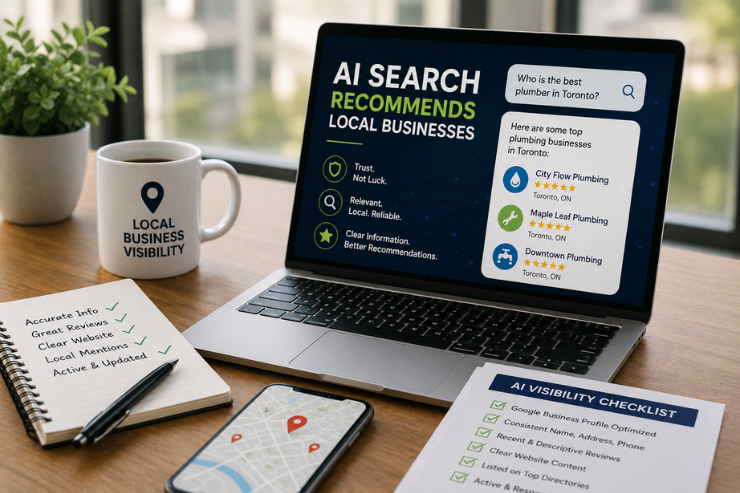
If you run a local business in Toronto, this is especially important because AI search can influence customers earlier in the decision-making process. A customer may ask for recommendations before they ever visit your website. They may compare businesses inside an AI tool. They may ask which provider is best for their type of problem.
If your brand is not clearly represented online, you may not be part of that conversation.
As a digital marketing company in Toronto and a marketing consultant for small businesses, we can help connect these pieces into a practical plan, especially if your current website has content gaps, Google Business Profile has weak local visibility, or unclear messaging.
If your business wants to be recommended, referenced, or understood by AI-powered search platforms, your online presence needs to be clear, complete, and trustworthy.
Your website should explain what you do.
Your service pages should answer real customer needs.
Your blogs should educate.
Your FAQs should address common concerns.
Your reviews should support your credibility.
Your business details should be consistent everywhere.
When these pieces work together, your brand becomes easier for both people and AI tools to understand.
So, business owners, need to scale digitally? This is the right time to look beyond traditional rankings and ask a bigger question:
Is my business ready to be found in the next version of search?
If the answer is unclear, a professional audit can help identify what needs to be improved.
Want your business to show up where customers are searching next? Get a complete SEO and AI visibility audit from We Love Digital Marketing.