

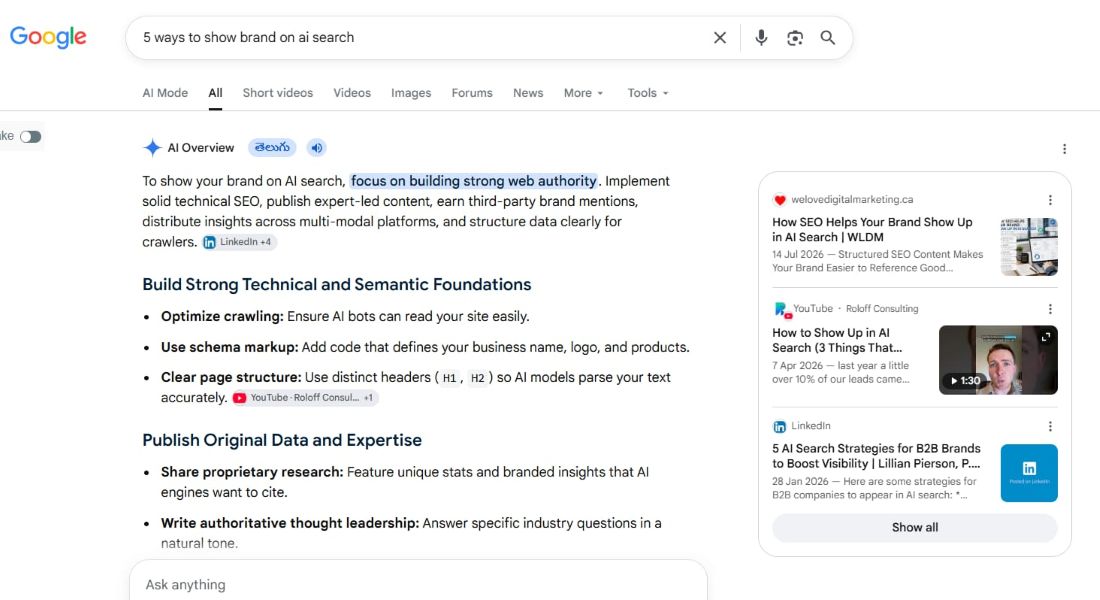
A few weeks ago, we searched for something we often write about “Ways a brand can show up in AI search.” We do this kind of search regularly to see how results are changing. This time, one of our own blog posts was sitting inside the AI Overview at the top of the page, listed as one of the cited sources.
We looked into what we had done differently, and thought it was worth sharing as practical lessons are what help us learn and grow.
Google’s AI Overview sits above the traditional list of blue links. Instead of only showing ten results and letting the searcher click through, it pulls together a short, direct answer and lists the pages it drew that answer from.
Our blog was one of those listed pages.
What the above screenshot shows is different from ranking on page one.
Search behaviour is shifting and the change is visible in how people interact with Google every day.
If your website never gets pulled into AI-generated answers, you may be invisible in a growing share of searches, even if you still rank on the first page.
When we looked at that blog with fresh eyes, trying to figure out what it actually did differently because nothing about it felt unusual at the time we wrote it.
But a few choices stand out to us now, which are as follows:
A meta title that reflects the real question someone is asking gives both readers and AI systems a clear understanding about what the page is actually about.
These are not two separate strategies, they share the same foundation.
We are not saying that doing exactly what we did will get any business cited in an AI Overview. But the habits behind this result are accessible to any business.
None of this is complicated. What makes the difference is doing it consistently, over time, as a practice rather than a one-off campaign.
Mostly it confirmed something we already believed that the basics still work, even as the format of search results changes around them.
What we are seeing consistently is that AI-assisted answers are becoming the first stop for more searches. Traditional Google rankings are still relevant, and AI Overviews sit on top of them, not instead of them. But the weight is shifting. Businesses that focus only on rankings, without considering how their content reads to an AI system, are working with an incomplete picture.
It also reminded us that this is not something to chase once and forget. Search results, and the pages cited within them, change often. What worked for one query today may look different in a few months.
Q1. Can my business website appear in Google AI Overviews?
It is possible. There is no guaranteed method, but a website with clear, well-structured content and accurate information has a better chance of being pulled into an AI-generated answer than one that is vague or inconsistent.
Q2. How does Google decide which websites to cite in AI search?
Google has not published an exact formula. Based on what we have seen, content that directly and clearly answers a specific question with logical structure and a meta title that reflects real search intent tends to be favoured.
Q3. Is AI SEO different from traditional SEO?
Not really. It builds on the same foundation like clear content, good structure, and technical health. What changes is how that content gets used once a search engine reads it. Businesses with strong SEO foundations are already better positioned than those starting from scratch.
Q4. Do I need a special schema to appear in Google AI search?
Schema markup can help search systems understand your content more precisely that is particularly for business information, services, and FAQs. But it is one signal among many. Clear writing and logical structure matter just as much.
Q5. Can an SEO agency guarantee Google AI Overview citations?
No and any agency promising a guarantee here is not being accurate. What an agency can do is strengthen the content, structure, and authority signals that improve your chances of being considered as a source.