

You have been doing SEO and your website ranks, so you feel covered.
But something has quietly shifted. Customers are finding businesses differently now and some of your competitors are showing up in places your SEO was never designed to reach.
This is not about starting over. It is about understanding what changed and what that means for your business right now.
SEO was designed for a world where people searched Google, got a list of links, and clicked through to websites. That still happens but it is no longer the only way people find businesses.
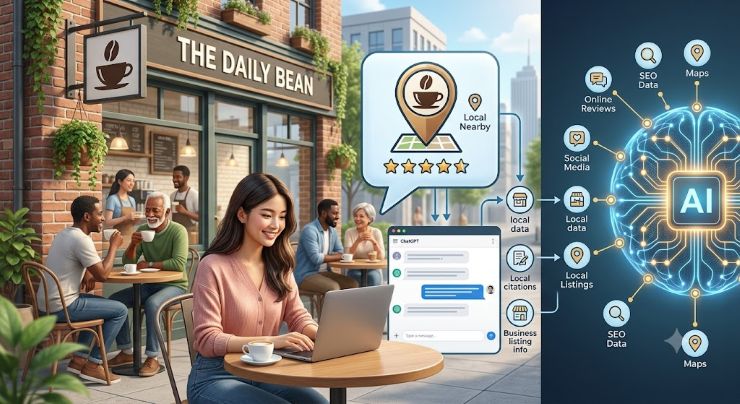
Today a growing number of people open ChatGPT, Google Gemini, or Perplexity and ask a question. They get a direct answer. With names. With recommendations. Without clicking a single link.
Here is what that looks like in real numbers:
Ranking number one on Google used to mean a steady stream of visitors. In 2026, that is no longer guaranteed.
This does not mean SEO is broken. It means ranking is now only half the picture.
GEO stands for Generative Engine Optimisation. It is the practice of making sure AI tools can find, understand, and confidently recommend your business when someone asks a relevant question.
Where SEO gets you ranked on Google, GEO gets you cited inside AI answers.
Two different outcomes. Both matter and none replaces the other.
The businesses showing up in both places are not doing twice the work. They are working right and in the right order.
This part is the most important distinction to understand.
| SEO: Google | GEO: AI Tools | |
| What it looks at | Keywords, backlinks, page speed, technical structure | Clarity, credibility, consistency, direct answers |
| What it rewards | Well-optimised pages | Trustworthy, clearly described businesses |
| What it produces | A ranked list of links | A direct recommendation or cited answer |
| What drives it | Algorithm signals | Language understanding and trust evaluation |
Here is what surprises most business owners.
A page can rank number one on Google and never appear in an AI answer. A business with no strong Google ranking can still be recommended by ChatGPT – if its online presence is clear, consistent, and credible enough for AI to trust.
They play by different rules. Understanding both is what separates businesses that are fully visible from those that are only partially found.
When AI answers a question directly, the user often never visits a website at all. This is called zero-click search and it is growing faster than most businesses realise.
For Canadian businesses this creates a specific challenge:
The businesses adapting to this are not just tracking website visits anymore. They are looking at a wider picture of where their brand appears and where it does not.
Old SEO content was built around keywords, structured to match what Google was scanning for.
GEO-ready content is built around questions, written the way a real customer would ask something out loud or type it into an AI tool.
What this shift looks like in practice:
The gap between content that was written for 2022 SEO and content that works for 2026 AI search is wider than most businesses expect.
Both SEO and GEO rely on trust but they measure it in different ways.
SEO trust signals:
GEO trust signals:
For local businesses in Toronto and across the GTA, this is genuinely an opportunity. Local trust signals are far more accessible than large-scale backlink campaigns.
The foundation that makes SEO work is largely the same foundation that builds GEO visibility.
If you have been investing in SEO properly, you are already closer to GEO readiness than you think.
The work is not starting over. It is understanding what already exists, identifying where the gaps are, and extending the right things in the right direction.
Website traffic alone no longer tells the full story of how visible your business actually is.
Alongside traffic, the businesses managing this well are looking at:
The temptation is to tackle everything at once. But the order in which SEO and GEO improvements get made, matters significantly. Starting in the wrong place means fixing symptoms rather than causes and creating more work later.
The right starting point is different for every business. It depends on what is already working, where the specific gaps are, and what the competitive landscape looks like in your category and city.
If you are working with a digital marketing company and this conversation has not come up yet, it is worth raising. And if you are looking for a team that understands both sides of this shift and knows how to assess where your business actually stands, We Love Digital Marketing is a good place to start that conversation.
Q1. Does GEO replace SEO entirely?
No, GEO extends SEO rather than replacing it. The same trust and authority signals that help you rank on Google also support GEO visibility. Businesses with strong SEO foundations are already ahead of those starting from scratch.
Q2. How do I know if AI tools are recommending my business?
The simplest starting point is to search for your service in your city on ChatGPT or Perplexity and see what comes up. What you find or do not find, tells you a lot about where your visibility currently stands.
Q3. Do I need a large budget to improve GEO visibility?
Not necessarily. Many of the most impactful GEO improvements are about consistency and clarity rather than spend. That said, knowing which improvements to make first and how to make them correctly, typically requires more expertise than most business owners have time to develop alongside running a business.
Q4. How is GEO different from just producing more content?
Volume is not the answer. AI tools cite content that directly and clearly answers a specific question, not content that broadly covers a topic. One well-structured, question-focused page done properly will outperform ten generic blogs for GEO visibility every time.
Q5. How long before GEO improvements start showing results?
There is no fixed timeline and anyone who gives you a guaranteed number is guessing. Businesses with stronger existing SEO foundations tend to see GEO results faster. For most Canadian businesses making consistent, well-directed improvements, meaningful visibility typically builds over two to four months.