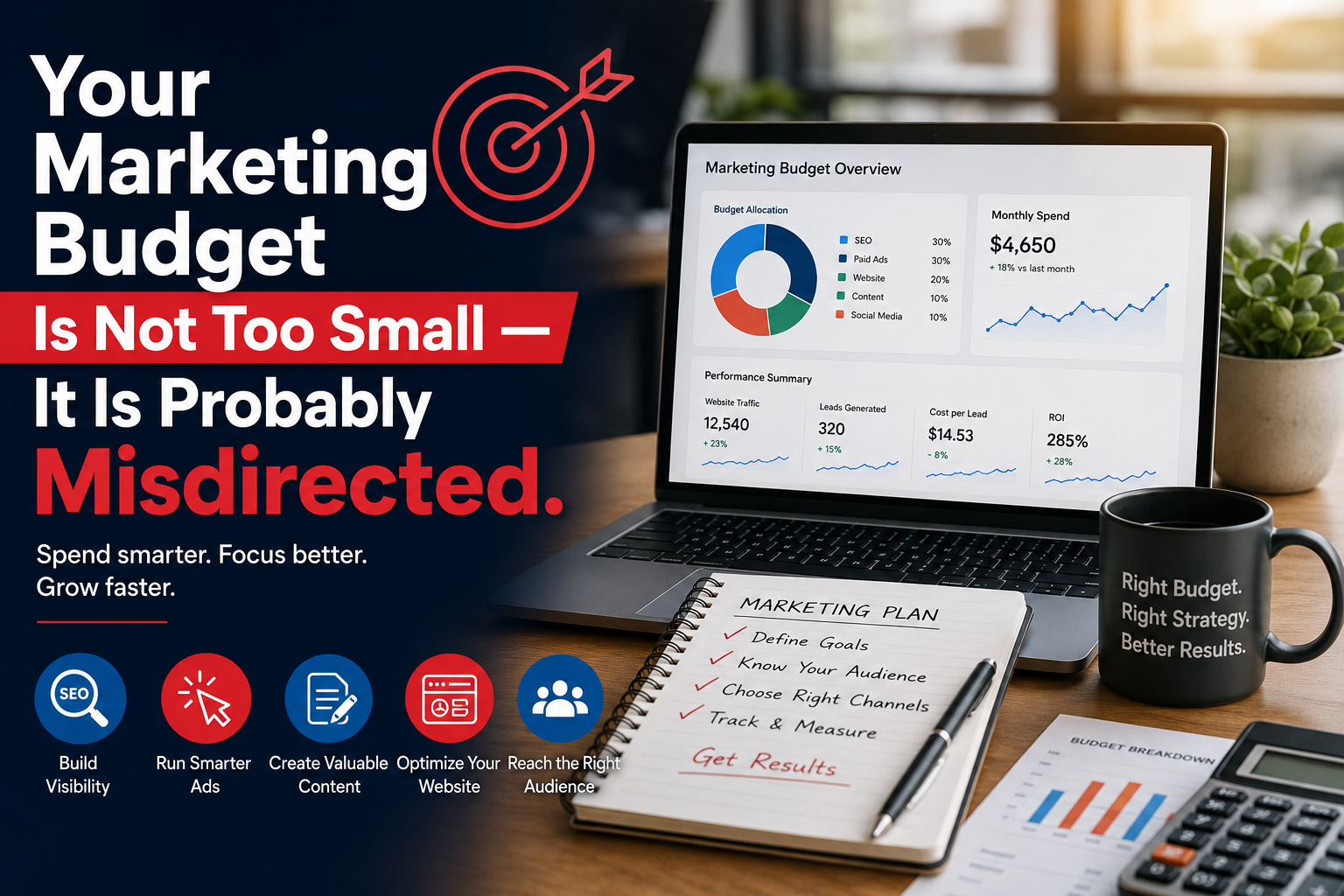
It is one of the most common questions business owners ask and one of the least honestly answered.
Most agencies either avoid the number entirely or give a vague range that means nothing without context. The truth is, there is no single right answer. But there is a smart way to think about it and that is exactly what this blog breaks down.
Whether you are just starting out in Brampton, scaling a service business in Toronto, or running a growing operation in Calgary, this will help you figure out where your marketing budget should actually go.
Why Most Budget Conversations Go Nowhere
Here is what usually happens.
A business owner asks an agency how much they should spend. The agency asks about their goals. Then comes a proposal that conveniently fits whatever the agency offers.
That is not a budget conversation. That is a sales conversation.
A real budget discussion starts with your business – your revenue, your growth stage, your current visibility, and what is actually working. Without that context, any number is just a guess.
The Percentage Rule and Why It Does Not Always Apply
You may have heard this one before.
The general guideline suggests businesses allocate 5 to 10 percent of their revenue toward marketing. Established businesses tend to sit closer to 5 percent. Businesses in growth mode or competitive markets often go higher, closer to 10 to 15 percent.
This is a useful starting point. But it has real limitations for small businesses.
- A business making $200,000 a year allocating 5 percent has $10,000 for the entire year, that is $833 a month across every channel
- A business making $800,000 with the same percentage has $40,000, a very different conversation
- A brand new business with little revenue but big growth goals may need to spend above the guideline early on to gain traction
The percentage rule is a reference point. It should not be treated as a formula.
What Stage Is Your Business At?
This matters more than any percentage.
- Just starting out: The priority is visibility – getting found by the right people. A website that converts, local SEO, and a Google Business Profile are the foundation. Paid ads can accelerate early traction but need a clear purpose and a landing page that is ready to receive traffic
Realistic starting range: $1,000 to $2,500 per month
- Growing and established: You have customers. You have some visibility. Now the goal is to grow consistently without relying on referrals or word of mouth alone. This is where a more balanced approach – SEO, content, paid ads, and social starts to make sense as a system
Realistic range: $2,500 to $6,000 per month
- Scaling and competing: You are in a competitive market – Toronto, Vancouver, Calgary – going up against businesses that are investing heavily in their digital presence. Underinvesting here means losing ground quietly.
Realistic range: $6,000 to $15,000 per month and above
These are not fixed rules. They are honest benchmarks based on what actually moves the needle in the Canadian market right now.
Where Should the Budget Actually Go?
This is where most business owners get it wrong and not the total amount, but the allocation.
Here is a practical breakdown by channel:
- Search Engine Optimisation (SEO): Slow to start but the highest long-term return. Once rankings are established, traffic comes without paying for every click. For most Canadian small businesses, SEO should form the foundation of any sustained digital strategy.
Typical investment: $800 to $2,500 per month depending on competitiveness
- Paid Advertising – Google Ads and Meta: Fast results when the setup is right. But it stops the moment the budget stops. Best used to accelerate growth while SEO builds, or for specific campaigns, launches, and seasonal pushes.
Typical investment: $500 to $3,000 per month in ad spend, plus management
- Website Often overlooked as a marketing expense but it is the foundation everything else sends traffic to. A slow, unclear, or outdated website undermines every other channel.
Typical investment: $3,000 to $8,000 for a build, plus ongoing maintenance
- Social Media Marketing: Essential for brand visibility, trust, and community but not always the fastest route to direct leads. Works best when paired with content strategy and occasional paid social.
Typical investment: $500 to $2,000 per month
- Content Marketing: Blogs, guides, videos, and resources that build authority and support SEO over time. One of the highest-value long-term investments a Canadian business can make but requires consistency.
Typical investment: $500 to $1,500 per month
The Hidden Costs Most Business Owners Do Not Plan For
This is where budgets quietly fall apart.
- Tools and software: Analytics platforms, scheduling tools, CRM systems, email marketing software. These add up to $200 to $800 per month depending on what you use
- Creative assets: Photography, video production, graphic design. Often underbudgeted and then rushed
- Website maintenance: Hosting, updates, security, plugin renewals. Easy to forget until something breaks
- Testing and iteration: Good paid campaigns require testing. Budget for learning, not just running
When you add these up, the real cost of a functional digital marketing operation is often 20 to 30 percent higher than the headline number.
Spending Smart vs Spending More
A bigger budget does not automatically mean better results.
In the GTA and across Canada’s competitive markets, businesses that spend smart consistently outperform businesses that simply spend more. Spending smart means:
- Fixing your website before driving traffic to it
- Building SEO foundations before scaling paid ads
- Choosing two or three channels and doing them well, rather than spreading thin across everything
- Measuring what is actually driving enquiries and not just what looks active
Working with a digital marketing agency for small businesses that takes the time to understand your goals, your market, and your current position before recommending a budget is the difference between money well spent and money well wasted.
What a Realistic Starting Budget Looks Like in Toronto and the GTA
To make this concrete, here is what a realistic, entry-level digital marketing investment looks like for a small service business in the GTA:
| Channel |
Monthly Investment |
| SEO |
$1,000 |
| Google Ads (spend + management) |
$1,200 |
| Social Media |
$600 |
| Content |
$400 |
| Tools and software |
$200 |
| Total |
~$3,400 per month |
This is not a large budget by agency standards. But allocated correctly with a solid website already in place, it is enough to build consistent visibility and generate regular enquiries for most local service businesses in competitive Canadian markets.
When to Increase Your Marketing Spend
There are clear signals that it is time to invest more.
- You are turning away work because you cannot handle the volume, reinvest to build capacity
- Your competitors are visibly outranking you and outspending you
- A new product, location, or service needs traction quickly
- Your current marketing is working and you want to scale what is already converting
And equally, there are signals to hold back.
- Your website is not ready to convert the traffic you are already getting
- You do not have clarity on what is currently working and what is not
- You are about to enter a new market and need to test demand first
A good small business marketing consultant will help you read these signals honestly and build a strategy around them rather than around what the agency wants to sell.
The Budget Is Not the Problem. The Strategy Behind It Is.
There is no magic number. But there is a smart way to approach it.
- Start with your business stage and not a percentage
- Build the foundation before scaling the spend
- Allocate across channels based on your goals and not trends
- Account for the hidden costs most people forget
- Measure what is actually working and adjust
Digital marketing done well is not an expense. It is the most scalable investment a Canadian small business can make.
The question is not whether to spend, it is where to spend first, and how to make sure every dollar is working as hard as it can. That is the conversation We Love Digital Marketing starts with every Canadian business, before anything else.
Frequently Asked Questions
- How much do small businesses in Canada typically spend on digital marketing?
Most Canadian small businesses spend between $1,000 and $5,000 per month on digital marketing depending on their industry, location, and growth stage. Businesses in competitive markets like Toronto and Vancouver often invest more to stay visible. The right amount depends less on what others spend and more on what your business actually needs right now.
- Is it better to spend on SEO or paid ads first?
It depends on your timeline. If you need leads within weeks – paid ads. If you are building for the next 12 to 24 months – SEO. Most Canadian small businesses benefit from starting with SEO foundations and using paid ads selectively for specific campaigns or launches. A marketing consultant for small businesses can help you sequence this correctly based on your current position.
- Can a small business in Canada do digital marketing on a tight budget?
Yes but it requires focus. Trying to do everything with a small budget usually means doing nothing well. Pick one or two channels, do them properly, and build from there. Local SEO and a well-optimised Google Business Profile are often the highest-return starting points for budget-conscious Canadian businesses.
- How do I know if my marketing budget is working?
Track where your enquiries are actually coming from. Google Analytics, call tracking, and regular reviews of which channels are driving contact form submissions or calls are the clearest indicators. If you cannot trace a lead back to a specific channel, your measurement is the problem, not necessarily your budget.
- When should I hire a digital marketing agency instead of doing it myself?
When the time cost of doing it yourself outweighs the money cost of hiring someone else and when the skill gap is affecting results. A digital marketing agency for small businesses in Canada that is transparent about what your budget can realistically achieve will always be a better investment than an expensive agency that overpromises and underdelivers.