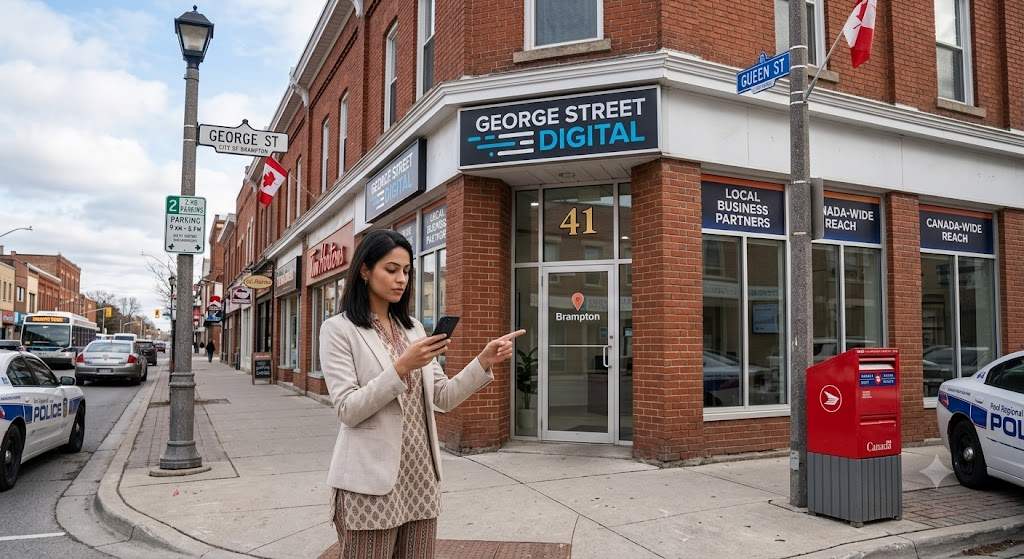


When someone asks for a local recommendation, such as, a duct cleaner in Toronto, a blinds company in Edmonton, an event venue in Brampton, ChatGPT acts as a live research assistant.
It reads the web in real time, pulls from directories, reviews, and structured website content, and builds an answer from what it finds. If a business is not visible in those sources, in the right format, it does not make the list.
ChatGPT rarely cites generic service descriptions. Instead, it prioritizes pages that directly answer a specific question a customer would ask. This distinction matters enormously for your content strategy.
The Action Plan: Move away from short keyword strings. Build one dedicated page per core service designed to satisfy a long-tail user problem (e.g., “How to stop afternoon heat using motorized blinds”). Apply FAQ Schema markup to your code so AI crawlers recognize each question and answer as a distinct, extractable unit.
When ChatGPT scans the web to answer a local query, it is doing more than checking if you exist, it is determining if your business is safe to recommend. Every source it reads either strengthens or weakens its trust rating.
What consistent presence across sources signals to ChatGPT:
NAP (Name, Address, Phone Number) consistency is the glue that holds this together. Your contact details must be identical everywhere. Even a tiny discrepancy like writing “Road” on your website but “Rd.” on a directory creates a data gap. AI reads that gap as a lack of data integrity and may drop you from the recommendations.
Technical barriers are invisible to the business owner but immediately visible to AI crawlers.
The most common issues found:
AI tools evaluate trust through the E-E-A-T framework, that is, Experience, Expertise, Authoritativeness, and Trustworthiness. Each one can be built deliberately.
Note on Reviews: A steady stream of two to three highly specific reviews a week builds immense credibility. Velocity spikes (e.g., ten reviews in one day followed by weeks of silence) look manufactured. Reviews that say, “Booked an event venue walkthrough in Brampton; the team showed us three layouts and confirmed pricing on-site,” feed the AI rich, contextual data to match with future searches.
A website where pages exist in isolation gives AI no way to understand the relationship between services, locations, and expertise.
What internal linking signals to AI:
Technical fixes show impact within weeks. Content and external presence take three to six months.
You do not need to start over. What it takes is maintaining consistent information across platforms, structuring content so AI can extract it, and building a steady presence across the Canadian sources ChatGPT trusts.
The businesses showing up in ChatGPT recommendations across Canada built this presence gradually with a few directory listings corrected, a few service pages rewritten, a review process put in place and maintained. We Love Digital Marketing helps Canadian businesses build that layer by starting from what already exists and closing the gaps that are actually holding visibility back.
Q1. How long does it take to show up in ChatGPT recommendations?
Technical fixes can show results within weeks. Building reviews, directory listings, and external presence typically takes three to six months of consistent effort.
Q2. Does Google Business Profile affect ChatGPT recommendations?
Yes. ChatGPT reads GBP as a primary local data source. An incomplete or inactive profile is one of the most common reasons a business gets skipped.
Q3. Why does ChatGPT recommend competitors with fewer reviews?
Review volume is one signal among many. Consistent directory listings, a complete profile, and descriptive review content often outweigh raw review count.
Q4. Does schema markup actually make a difference for ChatGPT?
Yes. Schema tells AI crawlers exactly what a business does and where, instead of leaving it to guess. Without it, AI often moves to a clearer source instead.
Q5. Can a small Canadian business compete with larger companies in AI search?
Yes. ChatGPT is not influenced by company size or ad spend. Consistent NAP, recent reviews, and clear service pages regularly outperform larger competitors with weak online presence.