

There was a time when getting your business found online meant one thing rank on Google. Pick the right keywords, build some backlinks, keep your website technically clean, and you showed up on page one. That was the game. Most businesses still play it.
But the game has changed. And the businesses that have not noticed are quietly losing visibility not to a competitor, but to a machine that answered the question before anyone could click.
Think about how you personally look something up now. More often than not, you are not scrolling through ten blue links. You are typing a full question into ChatGPT, asking Google’s AI Overview for a direct answer, or using Perplexity to get a summarised response with sources. You get your answer, and you move on without visiting a single website.
This is not niche behaviour anymore. The overlap between digital marketing and AI has already reshaped how brands reach their audiences — and search is simply the most visible place where that shift is playing out.
This shift is where GEO enters the picture.
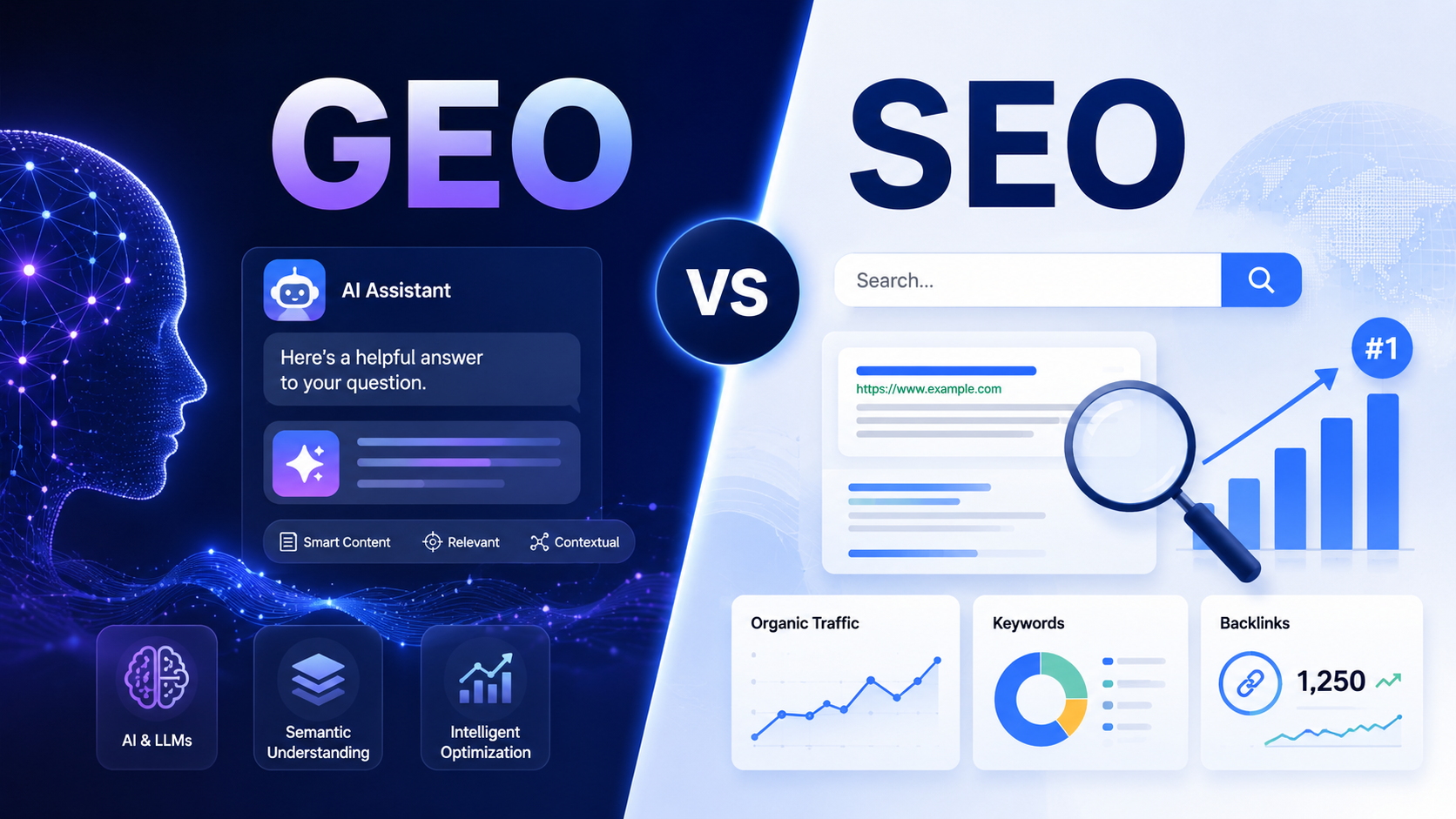
Generative Engine Optimization — GEO — is the practice of structuring and creating content in a way that AI systems can understand, trust, and use when generating answers for users.
SEO gets you a position on a list of results. GEO gets you inside the answer itself.
When someone asks an AI tool “what should I look for in a marketing strategy consultancy,” the AI does not show a ranked list of agencies. It synthesises information from sources it considers credible and authoritative, and produces a direct response. The brands cited in that response are the ones who have intentionally or not done GEO well.
If your content is not structured to be read, extracted, and trusted by AI systems, it does not matter how well you rank on Google. You simply will not appear in the growing number of conversations happening inside these tools.
They work together, but they are not the same thing.
Signals to a search engine that your page is relevant and worth showing through keywords, backlinks, page speed, and domain authority.
Determines whether your content is useful to cite — whether it answers questions clearly, demonstrates real expertise, backs up claims with data, and is written in a way an AI model can confidently extract and reference.
Research shows only 10 to 40 percent of content cited by AI tools overlaps with traditional Google rankings, depending on the platform. They are measuring fundamentally different things.
This is why the conversation around digital marketing and AI is no longer theoretical. It is about real visibility, real traffic, and real revenue being redirected — right now. Brands that understand this connection early are the ones building a durable competitive edge.
When a potential customer asks an AI tool a question related to your product or service, one of three things happens:
Most businesses are sitting in outcome two or three and have no idea, because it simply does not show up in their Google Analytics. For anyone operating at the intersection of artificial intelligence and marketing, this is the most important structural shift in a decade and early movers are already pulling ahead.
The brands benefiting most right now are not necessarily the largest. They are the ones whose content is built to be trusted by humans and AI systems alike.
You do not need to throw out your existing content strategy. GEO builds on good SEO fundamentals, but it asks some additional questions. For any marketing strategy consultancy advising clients today, these are the questions that separate forward-thinking strategy from outdated execution.
AI systems weigh what appears at the top of a page heavily. Lead with a direct answer — not a slow build-up.
Specific data, named sources, and demonstrable expertise signal to AI tools that your content is trustworthy and worth citing over vague or promotional writing.
Thought leadership, guest publishing, and earned citations across the web train AI systems to associate your name with your area of expertise.
Interconnected content that builds topical authority performs significantly better than isolated posts written around a single keyword.
None of this requires a complete overhaul. It requires a shift in intent from writing for a ranking algorithm to writing for an intelligent system that is genuinely trying to help a human being.
SEO is not dead. It is the foundation. But in 2026, the foundation alone is not enough. GEO is what sits on top — and increasingly, it is what determines whether your business gets found at all in an AI-first world.
The businesses winning right now are the ones making themselves easy for AI to understand, cite, and recommend. That requires clear content, real authority, and a strategy built for where artificial intelligence and marketing are heading together — not where they have been.
At We Love Digital Marketing, this is exactly what we help brands navigate.
Ready to show up where your customers are actually searching? Let’s build a content and visibility strategy that works for today’s AI-driven landscape.
1. What is the difference between SEO and GEO?
SEO focuses on ranking your content in traditional search results like Google. GEO focuses on getting your content cited inside AI-generated answers on platforms like ChatGPT, Google AI Overviews, and Perplexity. Both matter, but GEO addresses a newer and fast-growing part of how people discover information online.
2. Does GEO replace SEO?
No. GEO works alongside SEO, not against it. A strong SEO foundation actually supports GEO, since AI systems tend to draw from content that already has credibility signals. Think of GEO as the next layer of your visibility strategy — not a replacement for what you have already built.
3. Why is my organic traffic dropping even though my rankings have not changed?
This is often called “AI displacement.” When Google’s AI Overview answers a query directly at the top of the page, users get what they need without clicking through to any website. Your ranking may be intact, but the AI is answering above it — and fewer people are making it to your site.
4. Does E-E-A-T still matter for AI search?
More than ever. Experience, Expertise, Authoritativeness, and Trustworthiness is one of the primary filters AI systems use to evaluate whether content is worth citing. Content backed by real expertise and verifiable data consistently performs better — which is why it sits at the core of what any credible marketing strategy consultancy should be building toward today.
5. How do I know if my content is appearing in AI-generated answers?
Standard analytics tools will not show you this clearly yet. Specialist tools such as Semrush’s AI Toolkit, BrightEdge, and Profound are designed to track your brand’s share of voice across AI platforms. As digital marketing and AI continue to converge, monitoring your visibility in these tools is becoming as routine as checking your Google rankings.