
Every customer wants to feel like a brand gets them. Not in a generic “here’s your first-name email” kind of way, but genuinely understood. Known. Anticipated.
That’s exactly what AI in marketing is making possible, and it’s changing the customer journey in ways that would have seemed ambitious just three years ago.
If you’re a business owner or marketer in Canada trying to figure out where digital marketing and AI intersect with real growth, this blog breaks it down clearly, practically, and without the jargon.
The customer journey is the full path someone takes from first discovering your brand to making a purchase and everything that happens after.
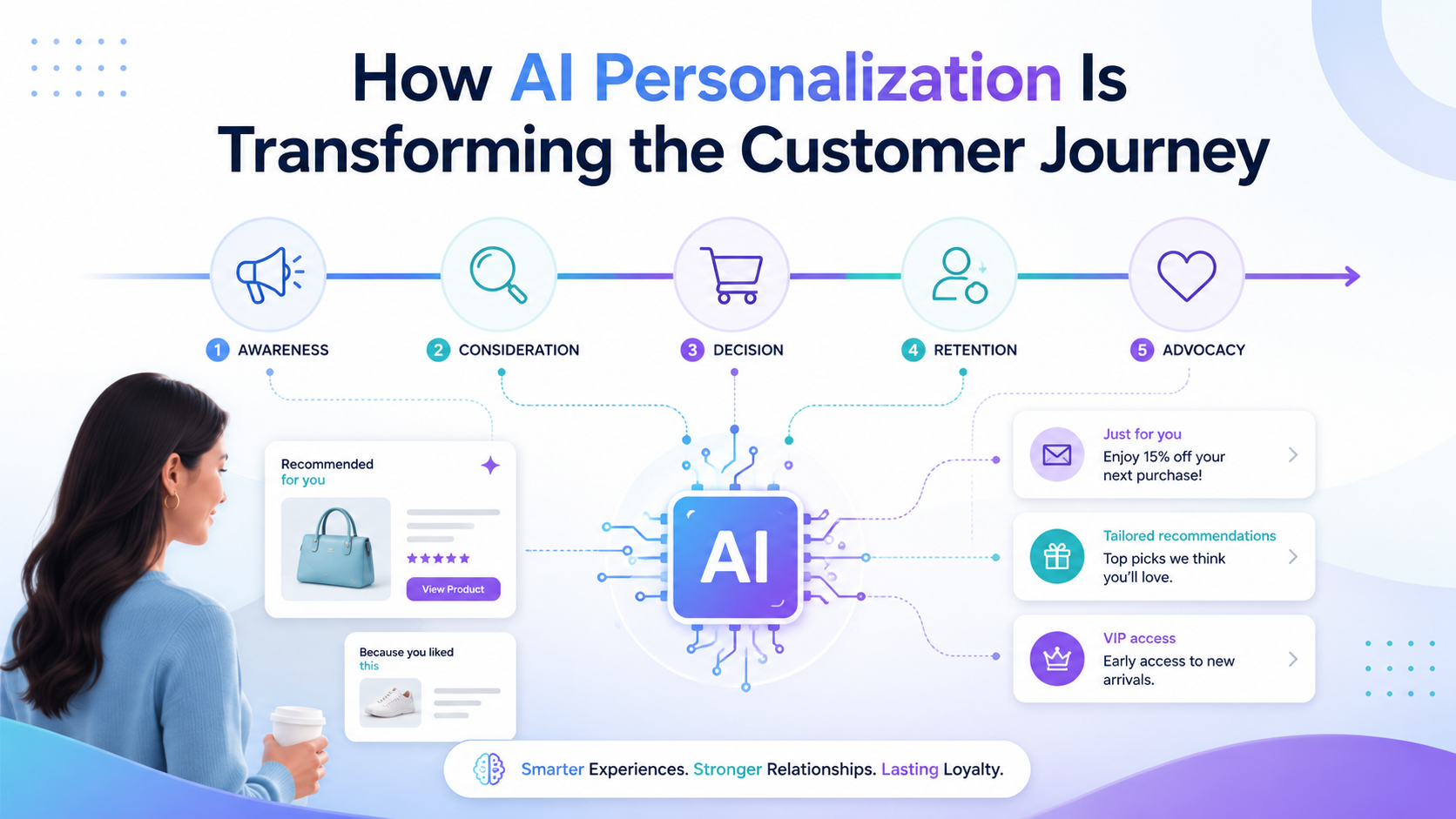
It typically moves through five stages:
Traditionally, marketers treated these stages as broad buckets with the same message for everyone at each step. AI is dismantling that approach entirely.
AI personalization is the use of machine learning and data analysis to deliver experiences, content, and messaging that are tailored to each individual user in real time.
It goes far beyond putting someone’s name in a subject line.
We’re talking about:
This is artificial intelligence in marketing working at its most practical — and most powerful.
AI helps brands reach the right people before they even know they need a product. Predictive algorithms analyse behavioural patterns across platforms to identify high-intent audiences, people who are likely to convert, not just people who match a demographic profile.
Tools like Meta’s Advantage+ and Google’s Performance Max are already doing this at scale. The result? Less budget wasted. More relevant first impressions.
This is where personalization gets particularly powerful. AI tracks how a user engages with your website, your emails, your ads — and uses that data to serve content that matches exactly where they are in their thinking.
Someone who reads three blog posts about kitchen renovations gets a different follow-up than someone who only looked at your pricing page once. Artificial intelligence for marketing makes this level of precision not just possible, but automatic.
AI-powered chat tools, smart product recommendations, and dynamic landing pages all reduce friction at the point of purchase. They answer objections before a customer even voices them.
A well-implemented AI layer here can meaningfully lift conversion rates — not through pressure tactics, but by making the buying decision feel easy and well-informed.
Keeping customers is cheaper than acquiring new ones — everyone knows that. AI makes retention smarter by predicting when a customer is likely to churn and triggering the right intervention before they leave.
Think: a loyalty nudge, a personalized re-engagement email, or a tailored product recommendation based on purchase history. This is where a solid consulting marketing strategy pays off — mapping AI tools to actual business goals, not just deploying technology for its own sake.
Happy customers who feel genuinely understood become brand advocates. AI helps identify which customers have the highest advocacy potential and activates them with the right messaging at the right moment — whether that’s a referral prompt, a review request, or exclusive early access to something new.
This isn’t theoretical. The results are already showing up in data:
For any digital marketing agency in Toronto or beyond, these numbers make it very clear: personalization isn’t a nice-to-have anymore.
Knowing the benefits is one thing. Getting there is another. Here’s where most businesses hit a wall:
This is exactly why working with the best digital marketing agency Toronto businesses trust means more than just buying software. It means building a strategy first — then choosing the tools that serve it.
To make this concrete, here are real examples of artificial intelligence and marketing working together effectively:
These aren’t billion-dollar anomalies. The underlying principles — know your customer, deliver relevance, reduce friction — are scalable for businesses of any size.
The customer journey has never been more complex or more full of opportunity. Brands that use artificial intelligence in marketing to meet people where they are, with what they actually need, are building the kind of loyalty that doesn’t erode easily.
At We Love Digital Marketing, we help businesses across Canada build smarter marketing strategies — ones where AI works as a tool in service of a clear goal, not as a buzzword on a slide deck. Whether you’re looking to improve your email performance, sharpen your ad targeting, or build a full-funnel personalization strategy, we bring both the strategic thinking and the executional know-how to make it work.
Q1. Do I need a huge budget to use AI personalization in my marketing?
Not at all. Many AI-powered personalization tools — from email platforms like Klaviyo to ad tools like Meta Advantage+ — are accessible to small and mid-sized businesses. The key is starting with a clear strategy rather than buying every tool available. A focused approach with modest investment will outperform an expensive, scattered one every time.
Q2. How is AI personalization different from just using customer segments?
Traditional segmentation puts people into broad groups — age, location, purchase history — and sends everyone in that group the same message. AI personalization operates at the individual level, adapting in real time based on behaviour, context, and intent. The difference in relevance — and results — is significant.
Q3. Is AI personalization safe from a privacy standpoint?
It can be, when done responsibly. The best implementations rely on first-party data (information customers willingly share with you) rather than third-party tracking. With Canada’s PIPEDA regulations and evolving global privacy standards, transparent data practices aren’t just ethical — they’re essential for long-term brand trust.
Q4. What’s the first step to implementing AI personalization in my business?
Start with your data. Before choosing any tool, map out what customer data you currently collect, where it lives, and whether it’s clean and connected. A unified customer view is the foundation everything else builds on. From there, identify one stage of your customer journey to improve first — don’t try to personalize everything at once.
Q5. Can AI personalization work for B2B businesses, or is it mainly for e-commerce?
Absolutely works for B2B. In fact, personalization is arguably more important in B2B because sales cycles are longer and relationships matter more. AI can help B2B brands serve the right content at each stage of a longer consideration process, identify which leads are most likely to convert, and trigger the right outreach at the right time.