
Search has always been the backbone of digital visibility. But right now, something significant is shifting, and if you run a business or work with digital marketing solutions, you need to understand what’s happening before it starts showing up in your analytics.
Not too long ago, getting found online meant one thing: rank on Google’s first page. Invest in SEO, earn backlinks, optimize your metadata, and watch the traffic come in.
That model still works, but it’s no longer the whole story.
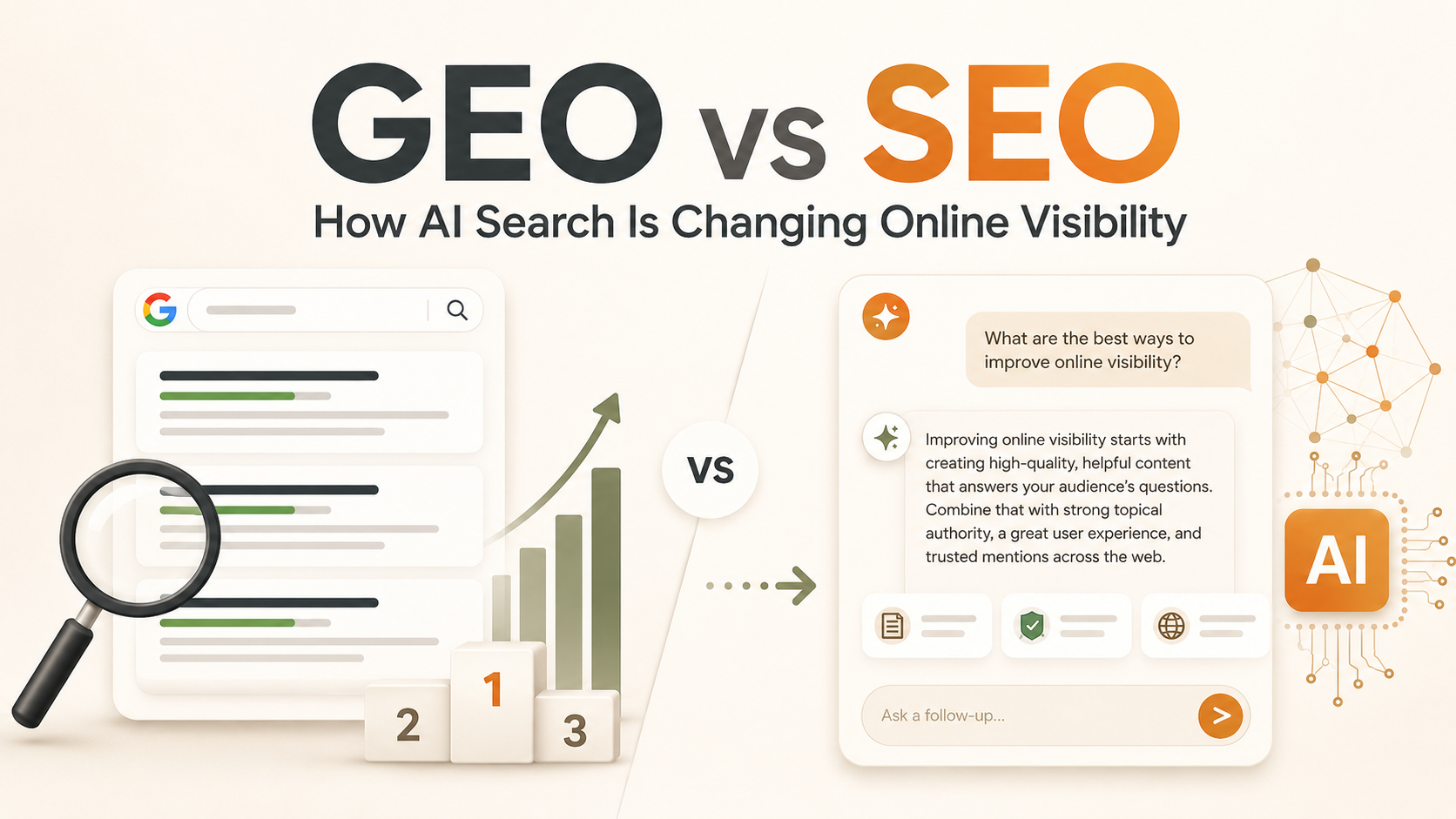
People are increasingly searching differently. Instead of typing keywords into a search bar and scrolling through results, they’re asking full questions to AI tools like ChatGPT, Google’s AI Overviews, Perplexity, and Copilot, and getting direct answers without ever clicking a link.
This is where a new discipline called GEO, Generative Engine Optimization, enters the conversation.
SEO (Search Engine Optimization) is the practice of making your website rank higher in traditional search engine results. When someone types “best dentist in Toronto” into Google, SEO is what determines whose website appears first.
It works through:
SEO is tried, tested, and still absolutely essential. But the way people consume search results is evolving — and that’s creating a gap that traditional SEO alone can’t fill.
GEO Generative Engine Optimization is about making your content visible inside AI-generated answers. Instead of showing up as a blue link on page one, you show up as the source an AI cites when someone asks it a question.
Think of it this way: when someone asks ChatGPT, “What’s the best mortgage rate strategy for first-time buyers in Canada,” GEO is what determines whether your brand gets mentioned in that answer or your competitor’s does.
This is where the relationship between artificial intelligence and marketing becomes impossible to ignore.
| Traditional SEO | GEO | |
| Goal | Rank in blue links | Get cited in AI answers |
| Visibility | User must click | User sees you without clicking |
| Measured by | Traffic & rankings | AI mentions & citations |
| Built on | Keywords & backlinks | Trust, structure & expertise |
| Result | Website visits | Brand authority |
Google’s AI Overviews now appear in roughly 25% of all searches — up from 13% just a year ago. Meanwhile, a SparkToro study found that 60% of Google searches end without a single click.
That means your potential customers are getting answers — but not necessarily landing on your website to get them.
For businesses investing in digital marketing and AI strategies, this is a wake-up call. Visibility in 2026 is no longer just about page rankings. It’s about being the brand an AI system trusts enough to recommend.
The good news? GEO and SEO aren’t opposites. A strong SEO foundation actually supports your GEO performance. Here’s what to focus on:
Any experienced digital marketing consultant will tell you: the brands winning at GEO today aren’t just chasing keywords, they’re building genuine authority across the web.
At We Love Digital Marketing, we help Canadian businesses stay ahead of exactly these shifts — from building rock-solid SEO foundations to crafting content strategies that get your brand cited by AI. Whether you’re just beginning to explore digital marketing and AI or you’re ready to build a full GEO strategy from scratch, our team is here to guide you.
Don’t wait for your competitors to get there first. Book your strategy call today.
Q1. Is GEO replacing SEO?
Not replacing — expanding. SEO is still foundational for driving website traffic. GEO adds a new layer of visibility inside AI-generated answers. Smart businesses are doing both, not choosing between them.
Q2. How do I know if my brand is showing up in AI search results?
You can manually test by asking tools like ChatGPT, Perplexity, and Google’s AI Overviews questions related to your industry and see whether your brand is cited. Dedicated GEO monitoring platforms like Evertune and Goodie AI offer more systematic tracking.
Q3. Does GEO work for small businesses, or is it only for big brands?
GEO is actually a significant opportunity for smaller businesses right now, because most SMBs haven’t started optimizing for it yet. Getting in early — especially in niche industries or local markets — can give you a first-mover advantage before competition intensifies.
Q4. How is GEO different from Answer Engine Optimization (AEO)?
GEO and AEO are closely related. AEO focuses on getting your content surfaced in voice search and direct-answer boxes (like Google’s featured snippets). GEO is broader; it targets AI-native platforms like ChatGPT and Perplexity that generate complete conversational responses, not just pull a snippet from a page.
Q5. How long does it take to see results from GEO?
GEO is a long-term authority play, similar to SEO. Consistently publishing high-quality, well-structured content with original insights typically shows meaningful improvement in AI citations over three to six months. There’s no shortcut but the compounding effect over time is significant.